
What to Look for When Choosing a Handheld Fiber Laser Welder
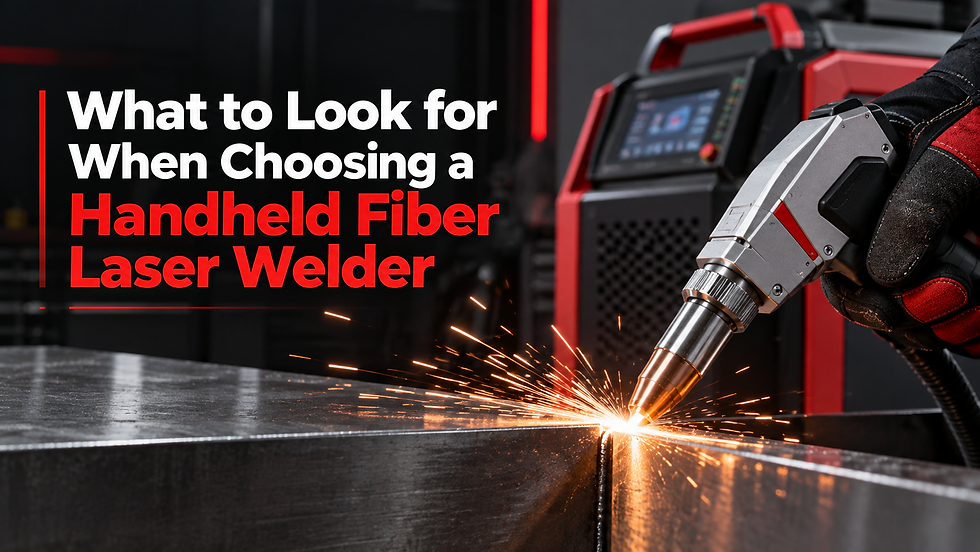
Handheld fiber laser welding has become an increasingly practical option for fabrication shops looking for controlled heat input, clean welds, and reduced secondary finishing.
But comparing machines based only on laser power does not tell the entire story.
Cooling, duty cycle, wire feeding, electrical requirements, process controls, safety monitoring, and serviceability can all affect how well a laser welder fits into day-to-day production.
Here are several areas to consider before choosing a system.
1. Laser Power
Start with the materials, thicknesses, and joint configurations you expect to weld.
Apache's compact APLW2500 Series is available in 1.5 kW and 2.0 kW configurations, while the APLW50030 provides 3.0 kW of laser power for applications requiring increased production capability.
More power is not automatically better. The appropriate power level depends on the work being performed.
The goal is to choose enough capacity for your application without adding unnecessary electrical or equipment requirements.
2. Duty Cycle and Cooling
Production welding generates heat, making the machine's cooling system an important part of the overall design.
A refrigerated chiller helps maintain controlled operating temperatures for both the laser source and welding gun.
Apache's APLW2500 and APLW50030 systems are designed for a 100% duty cycle under specified operating conditions, allowing extended production while maintaining controlled component temperatures.
For shops planning to use laser welding regularly rather than occasionally, cooling and duty cycle deserve close attention.
3. Wire Feed Capability
Laser welding can be performed as fusion welding or with filler wire depending on the joint and application.
An integrated wire feeder gives operators greater flexibility when filler material is required.
The APLW2500 incorporates a programmable wire feeder with support for wire spools up to 33 lb. The APLW50030 goes further with a standard dual-wire feed system while maintaining single-wire capability.
When comparing systems, consider not only whether a wire feeder is included but how easily operators can adjust wire-feed parameters for different jobs.
4. Programmable Weld Settings
Production consistency becomes increasingly important as multiple operators, materials, and part numbers move through a fabrication shop.
Programmable weld presets allow commonly used settings to be stored and recalled rather than manually recreated for every job.
The APLW2500 provides 10 programmable weld presets, while the APLW50030 expands that capability to 24.
Presets can help streamline setup when a shop repeatedly processes similar materials, thicknesses, or joint configurations.
5. Adjustable Welding Parameters
A flexible laser welder should provide operators with control over the welding process.
Depending on the system, adjustable parameters may include:
· Laser power
· Beam width
· Oscillation speed
· Laser frequency
· Duty cycle
· Wire-feed speed
· Continuous or pulsed wire feeding
These controls allow the welding process to be adapted to different materials and applications rather than relying on one fixed configuration.
6. Electrical Requirements
Electrical service is another important difference between welding systems.
The APLW2500 Series is single-phase compatible, which may simplify installation in facilities without three-phase electrical service.
The higher-power 3.0 kW APLW50030 uses three-phase electrical service, with an optional transformer available for common three-phase voltage configurations.
Checking electrical requirements early can prevent installation surprises later.
7. Safety Monitoring
Laser welding requires appropriate laser safety procedures, protective equipment, and controlled work areas.
The machine itself should also incorporate systems that monitor critical operating conditions.
Depending on the model, Apache's welding systems monitor areas such as:
· Welding gun temperature
· Laser source temperature
· Chiller temperature
· Shielding gas pressure
· Contact between the welding head and workpiece
These systems work alongside appropriate PPE and facility-specific laser safety procedures.
8. Serviceability and Support
A machine will eventually require questions, adjustments, routine maintenance, or replacement components.
Before purchasing, consider how accessible major components are and who you will contact when support is needed.
Apache builds its equipment around integrated, serviceable machine designs and emphasizes direct customer support. The company's equipment is assembled in Coffeyville, Kansas, and Apache highlights responsive customer service as a core part of its offering. Apache Industries Inc.
Choose the Welder Around the Work
The right handheld fiber laser welder depends on more than kilowatts.
Consider your typical material, production volume, electrical service, filler-wire requirements, desired process controls, and how frequently the machine will operate.
A well-matched system should fit into the workflow of the shop rather than forcing the shop to adapt around the machine.
Contact Apache Industries to discuss your welding applications and compare the fiber laser welding systems available for your production requirements.


Comments